If you are considering the Marina, you are probably wondering what it actually feels like to live there once the weekend buzz fades and real life begins. That is the right question, because the Marina is not just a pretty stretch of northern San Francisco with postcard views. It is a neighborhood with a very specific daily rhythm, and understanding that rhythm can help you decide whether it fits the way you want to live. Let’s dive in.
Marina life feels close at hand
One of the Marina’s biggest lifestyle strengths is how much of daily life is concentrated into a few familiar places. San Francisco Travel identifies Chestnut Street and Union Street as the neighborhood’s main commercial and social corridors, with Chestnut described as the Marina’s main shopping thoroughfare.
In practical terms, that means your day can feel compact and efficient. You can picture coffee, a quick retail stop, lunch, and evening plans happening within the same general loop rather than requiring a string of cross-city drives.
That compact layout gives the neighborhood an easy, social feel. Instead of planning your day around long travel times, you often plan around what sounds good within a few blocks.
Chestnut and Union shape the routine
Chestnut Street and Union Street do a lot of the heavy lifting in the Marina. According to San Francisco Travel, these streets are lined with restaurants, cafes, boutiques, retail, and local gathering spots that keep neighborhood activity centered and visible.
For you as a resident, that can make daily life feel more connected to the street. You are not tucked away from the neighborhood’s energy. You are living close to the places where people shop, dine, meet friends, and ease into the evening.
That street-oriented setup is a big part of the Marina’s appeal. It supports a lifestyle where going out does not have to mean making a major plan. Sometimes it just means stepping outside.
Walking is part of everyday life
The Marina lends itself to a walk-first routine. Because so many destinations sit close together and the waterfront is nearby, walking is not just recreational here. It is often the easiest way to move through the neighborhood.
That does not mean every resident lives car-free, but it does mean many daily tasks can happen on foot. The neighborhood’s setup naturally supports short walks for coffee, errands, dinner, or a quick reset by the water.
For buyers who value convenience, that rhythm can be a major draw. It creates a sense of ease that is hard to replicate in neighborhoods where daily essentials are more spread out.
Transit supports car-light living
If you commute or simply want options beyond driving, the Marina is served by several Muni lines. SFMTA lists routes including the 22 Fillmore, 30 Stockton, 30X Marina Express, 41 Union, 43 Masonic, 45 Union/Stockton, and 47 Van Ness.
The 30X Marina Express adds a useful detail for weekday commuters, with morning service into downtown. That gives some residents a more direct transit option during peak commute hours.
For many people, the result is flexibility. You may still want a car for convenience or weekend plans, but you are not limited to one way of getting around.
The waterfront is part of the routine
In some neighborhoods, open space feels like a bonus. In the Marina, it feels more central than that. Marina Green and Crissy Field are part of the neighborhood’s identity and help shape what everyday life looks like.
San Francisco Recreation and Parks describes Marina Green as a neighborhood park with grass areas, restrooms, par-course workout stations, and limited street parking. It also notes that the space hosts major events such as Fleet Week and Escape from Alcatraz.
Crissy Field adds another layer to the outdoor experience. The Golden Gate National Parks Conservancy describes it as a restored park with a flat, hard-packed promenade, beaches, picnic areas, birding, kayaking, windsurfing, and East Beach for waterside walks.
That mix makes the waterfront feel useful, not just scenic. It is the kind of setting you can fold into ordinary life, whether that means a morning run, an afternoon dog walk, stroller time, or a relaxed weekend by the Bay.
Outdoor time feels easy and repeatable
One of the most appealing things about the Marina is how easy it is to repeat the same good habits. When green space and waterfront paths are close by, getting outside can feel less like an event and more like part of your normal schedule.
That matters because lifestyle is often built from repeatable routines. In the Marina, the setting supports simple rituals like walking along the water, sitting on the grass, or taking in Bay views without needing to carve out a full day.
If you value outdoor access as part of your weekly rhythm, the Marina delivers it in a very visible way. The Bay is not in the background here. It is part of the experience.
Fort Mason adds social energy
Fort Mason helps extend the neighborhood’s outdoor and community feel. San Francisco Travel describes it as a popular gathering place, and it highlights Off the Grid: Fort Mason as California’s largest weekly food truck night market.
That gives the Marina a form of social energy that feels casual and easy to join. Recreation, food, and community activity often overlap, which helps the area feel active without relying on a traditional entertainment district.
For you, that can translate into more spontaneous plans. A waterfront walk can turn into a casual meal or a low-key evening out without much effort.
Dining is neighborhood-driven
The Marina’s food scene tends to feel local and repeatable. San Francisco Travel describes Union Street and Chestnut Street as home to neighborhood eateries, culinary standouts, cocktail lounges, and historic watering holes that primarily cater to locals.
That is an important distinction. The area does not read as destination dining only. It feels more like a neighborhood where you can find your regular coffee order, your go-to dinner spot, and a handful of places you return to often.
For many residents, that familiarity is part of what makes the Marina comfortable. It supports routines instead of constantly pushing you toward special-occasion planning.
Evenings are social and casual
Nightlife in the Marina is generally more relaxed than intense. San Francisco Travel describes Union Street as having a casual collegiate vibe, with sports bars and local watering holes shaping much of the evening atmosphere.
That means after-dark life often centers on dinners, patios, drinks, and bar hopping along a few active stretches. It is social, but it is not defined by a dense club scene.
If you like neighborhoods where evenings feel lively without feeling overwhelming, that balance may appeal to you. The Marina tends to offer energy in a way that still feels tied to daily life.
The housing feel is low-rise and cohesive
The Marina’s built environment plays a big role in how the neighborhood feels. San Francisco Heritage notes that much of the district was built quickly in the 1920s and early 1930s, with styles including Period Revival, Streamline Moderne, and Art Deco.
San Francisco Planning has also adopted a Marina-specific historic context statement related to the Panama-Pacific International Exposition and the development of the district. That reinforces the neighborhood’s recognized architectural and historical significance.
For you as a buyer, this often shows up as a visually consistent streetscape. Instead of a high-rise skyline or a patchwork of unrelated housing forms, the Marina tends to present a more cohesive low-rise character.
Architecture adds to the coastal feel
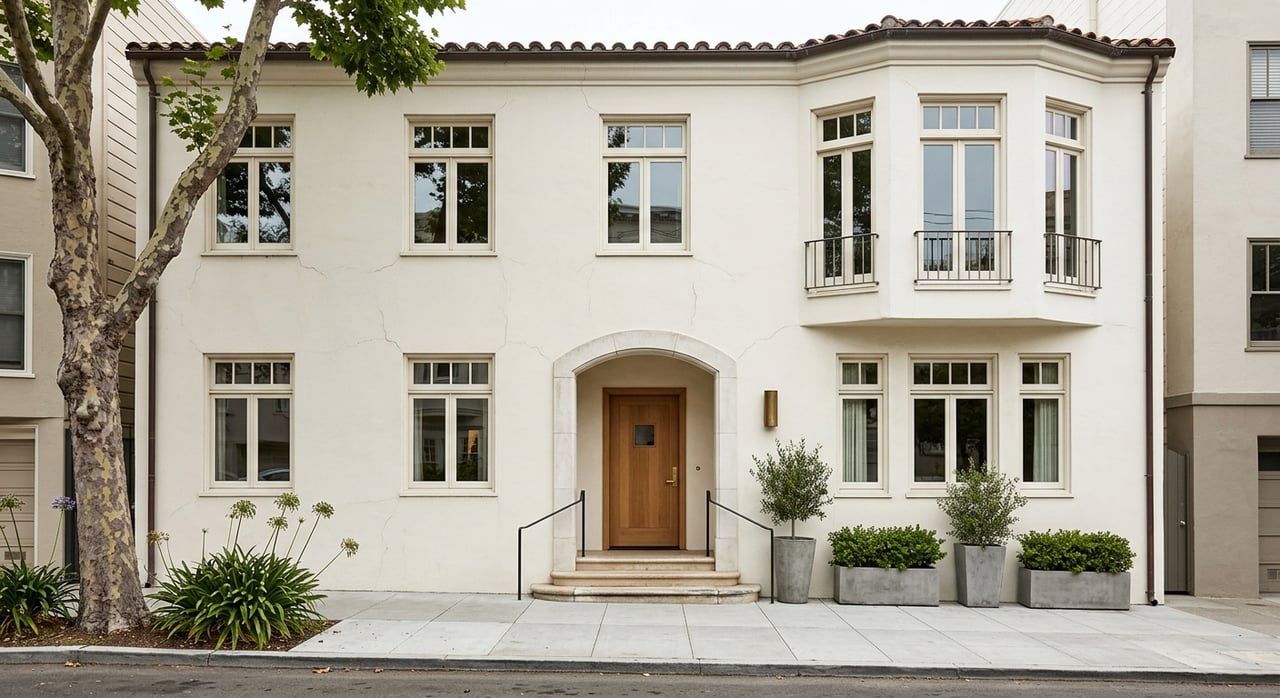
Planning materials also connect the Marina to Mediterranean Revival, Spanish Revival, Spanish Eclectic, Marina-style architecture, and Barrel-Front Mediterranean Revival. Together, those styles help explain why the neighborhood often feels light, coastal, and visually unified.
You see that influence in stucco exteriors, tile details, curved forms, and low-rise buildings that feel tied to the Bay setting. The result is a neighborhood character that feels distinct from other parts of San Francisco.
That visual identity matters because it shapes daily experience in subtle ways. The Marina does not just function differently from other neighborhoods. It looks and reads differently too.
What everyday life in the Marina really means
At its core, the Marina offers a lifestyle built around proximity. You are close to neighborhood retail and dining, close to waterfront open space, and close to a built environment that feels cohesive and established.
That does not mean it is the right fit for everyone. But if you want a San Francisco neighborhood where errands, meals, outdoor time, and social plans can all happen within a relatively compact area, the Marina makes a strong case for itself.
For many buyers, that is the real draw. The Marina feels active, social, and outdoors-oriented in a way that is easy to imagine living every day, not just visiting once in a while.
If you are exploring homes in the Marina or comparing San Francisco micro-markets, working with a neighborhood-savvy advisor can help you match the lifestyle to the right property. For tailored guidance on Marina and Cow Hollow homes, reach out to Gina G. Blancarte.
FAQs
What is daily life like in the Marina District of San Francisco?
- Daily life in the Marina tends to feel compact, social, and walkable, with much of the neighborhood’s activity centered around Chestnut Street, Union Street, Marina Green, and Crissy Field.
Is the Marina District in San Francisco walkable for everyday errands?
- Yes. Based on the concentration of shops, cafes, dining, and waterfront access, many everyday errands and outings can be done on foot within a relatively small area.
Does the Marina District in San Francisco have public transit options?
- Yes. SFMTA lists several Muni routes serving the area, including the 22 Fillmore, 30 Stockton, 30X Marina Express, 41 Union, 43 Masonic, 45 Union/Stockton, and 47 Van Ness.
What outdoor spaces define life in the Marina District?
- Marina Green and Crissy Field are key outdoor anchors, offering open lawns, waterfront walking paths, beaches, picnic areas, workout stations, and Bay views.
What is the Marina District dining and nightlife scene like?
- The Marina’s dining and nightlife scene is generally neighborhood-oriented and casual, with restaurants, cocktail lounges, sports bars, and local gathering spots concentrated along Chestnut and Union.
What kind of architecture is common in the Marina District?
- The Marina is known for low-rise housing from the 1920s and early 1930s, with styles that include Period Revival, Streamline Moderne, Art Deco, Mediterranean Revival, Spanish Revival, and Marina-style architecture.